





Selection Sunday for the 2026 NCAA Tournament is just one week away, and there is still so much to sort out before the final bracket is live. While a trio of dominant teams has emerged as locks to be No. 1 seeds, the overall picture will fluctuate significantly before the field of 68 is announced.
Conference tournament week should help sort out the clutter. Or, it may just throw the bubble picture further into chaos. Even among teams that are safely in the field, questions remain. Teams like Purdue and Iowa State are currently No. 3 seeds in CBS Sports Bracketology, but they haven’t been at their best down the stretch.
Can they stabilize through conference tournament runs and make a push for the No. 2 seed line? Or will they make early conference tournament exits and flirt with demotion? There isn’t a ton separating the worst No. 2 seeds from the best No. 5 seeds at the moment, which opens the door for some big winners to emerge from conference tournament week.
A strong showing could simplify the NCAA Tournament paths for teams in that range. Then, there is Kentucky. Will the Wildcats avoid landing in an 8/9 game that would potentially require a second-round showdown against a No. 1 seed? That’s up in the air as the Wildcats get set to play on the opening day of the SEC Tournament.
Here’s a full rundown of the biggest Bracketology questions and storylines to watch over the next week.
Bracketology top seeds
Check out the full field of 68 at the CBS Sports Bracketology hub.
The No. 1 overall seed
The battle for the No. 1 overall seed is a heavyweight bout between three teams — Duke, Michigan and Arizona — that separated themselves from the pack several weeks ago and have never looked back.
One week out from Selection Sunday, the Blue Devils sit atop the hierarchy with a 29-2 record and the No. 1 spot in WAB, along with the No. 1 spot in each of the three predictive metrics used by the committee. Duke also owns a potential trump card on Michigan in the form of a 68-63 neutral-site win over the Wolverines from late February.
But conference tournament week opens the door for volatility as these three juggernauts try to pair their regular-season conference titles with league tournament crowns. Without much separating the trio, deference is likely to be given to whichever team cuts down the nets.
The final No. 1 seed
Following another quality win at Kentucky on Saturday and UConn’s stumble at Marquette, Florida has seized the inside track for the final No. 1 seed. Most importantly, the Gators hold an edge on UConn in Wins Above Bubble (WAB), which is a vital resume metric used by the committee.
While UConn can point to a neutral-site head-to-head win over Florida from the nonconference slate, the selection committee historically treats that as one data point among many. As we hit the home stretch, the sheer totality of Florida’s resume is becoming difficult to ignore.
Bracketology: Florida passes UConn for fourth No. 1 seed as Selection Sunday nears
David Cobb
What would it take for UConn to seize the fourth No. 1 seed back? A Big East Tournament title combined with a Florida loss before the SEC Tournament title game might be enough.
Houston’s region
Houston successfully passed off its South Region hosting responsibilities to Rice, which cleared the path for the Cougars to be permitted to play in the South Region, which culminates in Houston. If the Cougars end up in the South and survive the first weekend of the Big Dance, they would play inside the Toyota Center for the Sweet 16 and Elite Eight, which would be a huge advantage.
Making that happen would likely require the Cougars to either be first or second in the No. 2 seed hierarchy. That will be determined in part by how Houston performs in the Big 12 Tournament and how other potential No. 2 seeds such as UConn, Michigan State and Illinois fare over the next week.
Suffice it to say, if a No. 1 seed ends up at a potential home-court disadvantage vs. the Cougars in an Elite Eight game, they won’t be thrilled. But under NCAA bracketing guidelines, it is permissible since Houston is not the host institution.
Carnage along the bubble
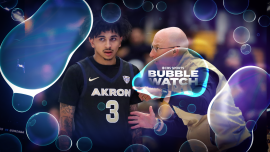
Saturday’s struggles from the bubble teams set the stage for what could be an epic conference tournament week. At-large spots are there for the taking. Is anyone willing to step up and grab them? Auburn’s candidacy is a topic of significant debate after the Tigers fell to 16-15 (7-11 SEC) with a loss at Alabama. Indiana lost again on Saturday. So did many of the other contenders for the final at-large spot in Bracketology.
Bracketology Bubble Watch: Risers and fallers following a day of epic carnage for NCAA Tournament hopefuls
David Cobb

For now, the final spot belongs to Stanford, which notched a huge Quad 1 win at NC State on Saturday. But there is no team that’s clearly deserving of the final spot in the field at this point, with a week to go until the field is announced. If it’s this hard to find 68 deserving teams, just imagine how challenging it would be if the tournament expanded to 72 or 76.
Bid thieves incoming?
The committee’s dilemma over who to select from a paltry group of contenders for the final at-large spots could be made easier with the emergence of bid thieves. The time-honored NCAA Tournament tradition of leagues getting a “bonus” team into the field amid the emergence of unexpected conference tournament champions is absolutely in play this year.
The MAC is a great example. While Miami (Ohio) is currently the league’s only team in the CBS Sports Bracketology field, the RedHawks would likely be safe as an at-large team even if they don’t win the MAC Tournament. So if anyone else wins the MAC Tournament title, the conference will likely send two teams to the Big Dance for the first time since 1999, which would create a crunch on the bubble.
Two more conferences to monitor for bid thieves: the Mountain West and the Atlantic 10. Utah State is safe from the Mountain West, and Saint Louis is likely safe from the Atlantic 10. Both leagues feature other bubble teams (New Mexico from the Mountain West and VCU from the Atlantic 10). But both conferences also have squads from outside the at-large picture fully capable of winning a conference tournament.
Bracketology Bubble Watch: Ranking which conferences are most likely to produce NCAA Tournament bid thieves
David Cobb
Conference race
The race to see which conference can place the most teams into the Big Dance is coming down to the wire. With a week to go, the SEC holds a narrow edge with 10 teams currently in the field.
Don’t mistake that tally for outright dominance, however. The Big Ten and Big 12 both have stronger collections of teams destined for high-end seedings in the final bracket.
The high-major conference with the most potential for volatility over the next week is the ACC. It currently has nine teams in the field, but Stanford and SMU are both among the “Last Four In” and could easily be left out depending on how things play out. SMU and NC State are also in the field as No. 9 seeds as of Sunday, but have been struggling mightily.
On the flip side, Cal remains in the hunt, and Virginia Tech is also on the outskirts of the bubble conversation. In summation, the ACC could go either direction this week. But regardless, this season’s haul for the league is guaranteed to be better than last year’s paltry group of just four teams.
Here is the rundown of every conference that currently has more than one team in the CBS Sports Bracketology field:
Bids by conference
SEC (10)
Big Ten (9)
ACC (9)
Big 12 (8)
Big East (3)
WCC (3)
Atlantic 10 (2)
Other potential multi-bid leagues: MAC, Mountain West
Injury situations
Unfortunately, season-ending injuries to key players have become a part of the Bracketology story for a few big-time teams. Most notably, Texas Tech lost leading scorer and rebounder JT Toppin for the season on Feb. 17. The reigning Big 12 Player of the Year was an irreplaceable force inside for the Red Raiders, who are now 3-2 without him.
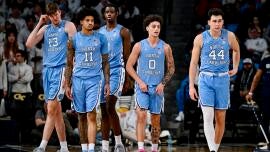
North Carolina is now 5-2 without leading scorer and rebounder Caleb Wilson. The freshman phenom is out for the season after suffering a broken right thumb in practice while ramping up for his return from an earlier injury. The Tar Heels have done an admirable job of staying level without Wilson, but it’s undeniable that their ceiling without him is lower.
What is next for North Carolina after Caleb Wilson’s season-ending injury?
Isaac Trotter
BYU is 3-4 without senior guard Richie Saunders, who suffered a torn ACL in the first minute of the Cougars’ win over Colorado on Feb. 14. He was BYU’s second-leading scorer and an elite offensive sidekick for freshman star AJ Dybantsa. The Cougars had been struggling mightily until edging Texas Tech 82-76 on Saturday in a battle of wounded Big 12 schools.
Here is the NCAA’s official stance on player availability in the selection process:
“The Division I Men’s Basketball Committee evaluates teams based on their full body of work and importantly their roster composition as of the start of the NCAA Men’s Basketball Championship. Player and coach availability is one of the key components in evaluating teams for selection and seeding the tournament field. The committee assesses how teams performed both with and without affected players or coaches, as well as considers the impact of player availability on game results for their opponents. The committee does not differentiate between the reasons for a player’s or coach’s availability, whether due to injury, discipline, or eligibility issues, as their role is simply the competitive assessment of teams.”


Add Comment