





Alabama circuit judge Daniel Pruet ruled in favor of the NCAA and against 23-year-old Alabama center Charles Bediako on Monday in an eligibility case that sparked widespread conversation and criticism across college athletics in recent weeks.
The decision figures to be a major one for the stability of college basketball, perhaps even for college sports. In quashing the temporary restraining order (TRO) Bediako had been playing under for the past five games, Pruet agreed with the NCAA’s arguments that Bediako was in violation of longstanding eligibility rules pertaining to college players, the NBA Draft and the deadline wall that separates college hoops from the NBA. That TRO was only initially granted after a different Tuscaloosa judge, who soon thereafter was found to be an active donor to Alabama’s athletic department, went on to recuse himself from the case after his situation was publicly disclosed.
The case went to the courtroom because the NCAA’s clearinghouse initially denied Bediako’s request for eligibility in January, and reasonably so. NCAA legal counsel argued last week that Bediako was breaking longstanding precedent by having played in college previously (2021-23), then left for the NBA, knowing full well what the rules were upon staying in the NBA Draft process.
There is a thorough process of information-gathering and vetting and the messaging is crystal clear: If you play college and stay in the draft process after the late-spring deadline, you give up your NCAA eligibility. The issue was so threatening to fundamental eligibility regulations, SEC commissioner Greg Sankey went so far as to write a sworn affidavit in opposition to one of his member schools — a letter that surely had an impact on the outcome.
Charles Bediako denied injunction against NCAA eligibility rules as Alabama return ends after five games
Carter Bahns
In light of the decision, questions still remain. Here’s a quick primer on where things stand and where Alabama (and Bediako) go from here.
What happens to Alabama now?
The Tide will move on and try to win without Bediako who, to be sure, is/was good enough to be a real factor in the SEC: he averaged 10.0 points, 4.6 rebounds and 1.4 blocks in his recent five game return . But he’s played his last game in college and he’ll make a return to the G League, where he most recently played just a few weeks ago for the Motor City Cruise.
With Bediako’s fate known, he and Alabama (which wasn’t technically part of the court case) have no further recourse. Alabama and Bediako lost their initial waiver request against the NCAA in January. We’re two-thirds of the way into the season and Bediako only had this remaining semester on his eligibility clock anyway. There won’t be an appeal or anything else at the legal level. This part of the story is done.
Will the NCAA count the games with Bediako on the roster?
Barring a stunner down the road, yes.
In terms of, will those three games be officially vacated at a later date? It seems unlikely.
The order explicitly prevented the NCAA from punishing Alabama as the TRO was in effect. The language in that first ruling stated the NCAA was “further restrained from threatening, imposing, attempting to impose, suggesting, or implying any penalties or sanctions on Mr. Bediako or the University of Alabama or its coaches or other student-athletes as a result of Mr. Bediako’s participation in Division I athletics.”
Now, does that sentence above no longer stand to scrutiny, since the TRO was retroactively wiped out? I wouldn’t expect the NCAA to pursue anything too heavily, but what remains unknown is how members of the NCAA Tournament selection committee will or will not choose to evaluate and/or judge Alabama for its Bediako gambit. This case rubbed a lot of people in college athletics the wrong way. While the NCAA is unlikely to officially sanction Alabama after the fact, the selection committee could have some interesting conversations behind closed doors next month when it comes time to seed the teams.
Alabama, Charles Bediako get last laugh in comeback win vs. Auburn thanks to Crimson Tide’s ‘G League dropout’
Isaac Trotter
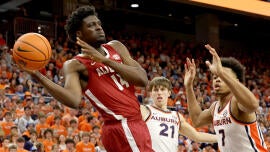
Why is this different from Baylor getting Nnaji eligible after he was drafted?
A natural question but there are three distinctions between Bediako’s case and James Nnaji’s.
1. Nnaji was cleared to play by the NCAA.
2. He was cleared because he never played college basketball prior to enrolling at Baylor in December 2025
3. Because he never played college basketball AND because he never signed an NBA contract, he was granted eligibility on a technicality
That technicality still has a lot of people unsatisfied with who does and does not qualify for college basketball.
Bediako’s challenge to the NCAA’s rule brought about a profound problem. If players are able to freely come and go from the NBA and G League ranks at nearly any time on the calendar, then roster stability would be under constant threat and outbound high school players would also see their opportunities tangibly affected.
What’s Alabama’s outlook heading into March?
Among top 25-level schools this season, the Tide rank near the top of the most inconsistent teams out there. At 16-7, Alabama owns nice wins over St. John’s on the road, Illinois in Chicago, a drubbing of Kentucky in Tuscaloosa and a defeat over Auburn on the road last Saturday. There’ve also been defeats at home to Texas and blowout losses against Florida and Arizona.
The problem for Bama now? Bediako offered relief for a thinning frontcourt in Tuscaloosa. Seven-footer Noah Williamson is hurt and 6-10 backup big Keitenn Bristow has missed 12 games this season. Taylor Bol Bowen, a 6-11 junior, has also been banged up this year. And just last weekend, in Alabama’s win over Auburn, 6-11 starter Aiden Sherrell suffered a knee injury
The lack of frontcourt presence and prominence is the biggest factor that’s prevented Alabama from being a top-10 team this season. Projected NBA Draft lottery pick Labaron Philon and sophomore combo guard Aden Holloway comprise the fastest guard duo in college basketball, but Alabama’s injuries have been an issue the entire season.
What does Alabama coach Nate Oats have to say?
As covered by Mike Rodak of 247Sports, Oats said he was “obviously super disappointed” on his radio show Monday night.
“I didn’t think it ever should have gotten to court,” Oats said. “I thought the NCAA should have made him eligible based on over a hundred current college basketball players — former professionals, most of them over in Europe. Some in the G League. Guys being drafted. Rights owned by NBA teams, as in James Nnaji being eligible to play.
“I thought it was kind of a no-brainer with the NCAA. Then I didn’t think it would be much of an issue. The NCAA hasn’t really changed much without courts forcing them to change. I thought the courts would see in the inconsistencies in the rulings and agree with Charles’ attorneys. To me, the NCAA’s point of why Charles shouldn’t be eligible was all these rules that they have, but they’re not applying those rules to all these other players they’ve made eligible. To me, it was very disappointing in the whole case. Disappointing for Charles.
“…Disappointed in the ruling. Disappointed in the system — both the NCAA, the courts, the whole thing, just with all the inconsistencies with who’s eligible and who’s not. It just seems like the European international players are being given preferential treatment over the Americans. It moreso happened today. Hopefully, at some point, somebody is going to win a ruling like this. It wasn’t here today. At some point somebody will win one and change the system. Because that’s how it has to get changed in the NCAA. They don’t make changes on their own, typically.”
Oats neglected to acknowledge the crux of the case, which is that Bediako was the only former college player to play, leave, and try to sue his way to returning. He has a point that there are former overseas pros who have been granted eligibility by the NCAA — by the truckload — in recent years. That’s another huge issue, and one that needs serious reconstruction and more stringent bylaws soon.


Add Comment