





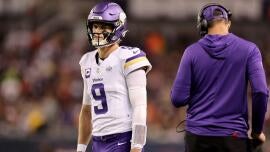
Six starts in, and J.J. McCarthy’s learning curve hasn’t just been steep — it’s forcing the Vikings to confront the very real possibility that they’ve tied their future to the wrong quarterback.
Ten months ago, Kevin O’Connell was named AP NFL Coach of the Year after the Vikings won 14 regular-season games with one-time castoff Sam Darnold. The team decided to let Darnold walk and put the offense in the unproven hands of McCarthy, the 2024 first-round pick.
McCarthy missed his rookie season with a knee injury and has made just six starts in 2025 after missing time with a high ankle sprain and, most recently, a concussion suffered in a Week 12 loss to the Packers. It was Minnesota’s third straight defeat, and yet more evidence that McCarthy isn’t close to being a franchise quarterback.
Darnold, meanwhile, signed a three-year, $105 million deal in Seattle and has the Seahawks at 9-3 after a decisive Week 13 win over … Minnesota — a game during which the Vikings were forced to start undrafted rookie Max Brosmer with McCarthy still in concussion protocol.
Vikings’ 294-game scoring streak comes to an end in 26-0 loss to Seahawks
Zachary Pereles
It’s not surprising that McCarthy has struggled; most young quarterbacks do. In the NFL, the windows are tighter, the pockets are smaller and tougher to navigate, and the game is much faster. What has been alarming, however, is that McCarthy appears to regress each week.
He’s battling accuracy issues, doesn’t play on time and often runs himself into pressures and sacks. While O’Connell and star wide receiver Justin Jefferson have said all the right things publicly, their body language tells a different story during games.
And soon, O’Connell and general manager Kwesi Adofo-Mensah will have to decide: Can the 22-year-old quarterback, six starts into his NFL career, be fixed, or is it already time to hit the reset button and move on?
The complication: O’Connell’s words before the season.
“I’ve thought a lot about this,” O’Connell told The Athletic back in early September. “And I’ve realized the most important part of a quarterback’s development is when it doesn’t go right. When there are growing pains, when there are struggles, that’s when you have to buckle up and put on your big-boy pants as a coach. You have to have a clear-cut plan on how you’re going to improve: what film to watch, what drills to do, how to measure progress, even if it’s really small.
“It’s our job as coaches to look inward first and exhaust every resource possible to get these guys to play like the best versions of themselves.”
O’Connell isn’t wrong. Too often, organizations give up on quarterbacks too soon, and they own much of the blame. None of that changes the fact that McCarthy has been historically bad to start his career. In fact, the numbers are somehow even more damning than the eye test.
The numbers confirm the nightmare

Eye test aside, the data is even harsher — and it puts McCarthy in a category reserved for the NFL’s biggest quarterback misfires.
Stacked against every first-round QB since 2016 who saw consistent playing time in their first two seasons, McCarthy’s first six starts paint a stark picture. He ranks 34th out of 35 QBs in EPA per dropback (-0.34), 32nd in completion percentage (54.2%), 34th in turnover-worthy throws (7.5%), and dead last in interceptions (10) and passer rating (57.9).
(In its simplest form, EPA per dropback is the average number of points a quarterback creates [or loses] for his team every time he drops back.)
* Jordan Love did start one game as a rookie, but didn’t make his next start until Year 3; Trey Lance only made four starts in his first two seasons; and Paxton Lynch made four total NFL starts in his career.
There’s more: while McCarthy has the best time-to–pressure numbers (2.73 seconds), he has one of the worst sack rates of all 35 QBs (11.2%, which ranks 31st), and his sacks-per-pressure rate of 25.3% is seventh worst. Without even watching a single snap, these metrics tell us that McCarthy holds the ball too long, drifts in the pocket, and when pressure finally gets home, he melts. He’s basically creating his own sacks. The protection is good; the decision-making isn’t.
Agent’s Take: Did the Vikings miscalculate their quarterback decisions by going all in on J.J. McCarthy?
Joel Corry
The outlier: The QB who survived a historically poor start
If you’re looking for a glimmer of hope in the table above, Jared Goff might be it. He is the only quarterback in the past 10 drafts to get off to a slower start over his first six games than McCarthy, according to EPA per dropback. And like McCarthy, Goff struggled with completion percentage (53.5%), interceptions (seven) and passer rating (61.7).
To understand how first-round quarterbacks overcome early struggles, I compared their first six NFL starts to their next 11 — which works out to a full 17-game season.
Goff didn’t truly become “Jared Goff, one of the NFL’s best quarterbacks,” until his 2021 breakout in Detroit, his sixth year in the league. But even in starts 7–17, he showed significant progress compared to his rocky first six outings.
Across those next 11 starts, Goff posted the largest EPA per dropback improvement of any of the 35 quarterbacks studied — nearly a half-point jump. Only Lamar Jackson (+0.35), Bo Nix (+0.33), and Baker Mayfield (+0.24) were even close. His completion percentage climbed from 53.5% to 61.5%, his TD-INT ratio improved from 5–7 to 16–4, and his passer rating skyrocketed from 61.7 to 97.9.
The McVay Factor: Improvement by design
Goff deserves credit for the quick improvement, but Sean McVay’s contribution was arguably more important. (Goff’s first seven starts came during his rookie season with head coach Jeff Fisher; starts 8-17 came in Year 2 with McVay, when the Rams went 11-5 and Goff made the Pro Bowl.) Essentially, McVay made it a priority to simplify the offense for Goff, never giving him more than he could handle. In fact, the first-year coach would err on the side of being too conservative over putting too much on the second-year quarterback’s plate.
If this sounds familiar it’s because it’s the same strategy Patriots offensive coordinator Josh McDaniels has used for young quarterbacks — most recently, Drake Maye, the No. 3 pick in the 2024 NFL Draft. (He went seven spots ahead of McCarthy.)
“I always talk about it … you guys all had a bucket,” McDaniels told Julian Edelman last offseason. “And yours was a big bucket at the end like you could handle whatever we gave you. Well, when you take a young quarterback, it’s more like a cup. …
“And when it gets to the top you got to stop … and then make sure that he has this and he can do it well. And then, okay, so then when he’s ready for more, then you get him a bigger cup, and then hopefully he ends up with a bucket. But there’s no shortcut. There’s no shortcut to it. And I think knowing where the player’s at is really important.”
The question for the Vikings is a simple one: Can O’Connell do for McCarthy what McVay did for Goff? Or what Sean Payton has done for Nix? Or can McCarthy find the confidence that has made Mayfield so successful? Or is there a scheme that better fits McCarthy’s skillset, much like the Ravens and Greg Roman did for Jackson early in his Ravens career?
Most QBs in this hole never climb out
The answers to all these questions, based on what we’ve seen through six games from McCarthy, are not encouraging — not even a little bit. Goff is the only modern quarterback who climbed out of a hole deeper than McCarthy’s. Everyone else in this range — from Zach Wilson to Justin Fields to Paxton Lynch — stayed stuck.
Even Darnold, who won 14 games a season ago, and Daniel Jones, who spent the final six weeks of 2024 with the Vikings, had much better starts to their careers.
|
Darnold |
-0.06 |
107 |
179 |
59.80% |
9 |
7 |
83.7 |
|
Jones |
-0.05 |
132 |
212 |
62.30% |
10 |
7 |
84.4 |
Neither quarterback improved over their next 11 starts — but they didn’t get worse, either. And sometimes just navigating your way through the growing pains of a full NFL season is reason enough to remain hopeful about a young quarterback’s prospects for success. And even then — and as O’Connell made clear in his comments before the season – you have to be patient enough to let that quarterback develop.
Sometimes that happens immediately (see Jayden Daniels, who balled out as a rookie but has struggled to stay healthy in 2025), sometimes it all comes together in Year 2 (Drake Maye is a legit MVP candidate), sometimes it takes several years and several teams for it to all come together (Mayfield, Darnold, Goff). And more often than not, it never works.
|
Darnold |
-0.08 |
215 |
370 |
58.10% |
13 |
16 |
70.5 |
|
Jones |
-0.07 |
260 |
425 |
61.20% |
16 |
10 |
82.0 |
So, yes, it’s easy now to say that the Vikings made a huge mistake letting Darnold or Jones leave. But Darnold, the third-overall pick in 2018, didn’t turn into one of the league’s most efficient quarterbacks until his fourth team and seventh NFL season. Jones, the sixth-overall pick in 2019, flashed in his fourth season (Brian Daboll’s first in New York), but it took another two years and two teams for him to reincarnate himself as “Indiana Jones” with the Colts.
Let’s revisit the first table above and again look at those QBs with the lowest EPA per dropback over their first six starts.
Of the 12 names – all drafted between 2016 and 2025 – only four are with their original teams. All four were drafted in 2023 or later and are still on their rookie deals. (Bryce Young, Bo Nix, J.J. McCarthy and Cam Ward, and Young was benched two weeks into his second season before regaining the job several weeks later, and he’s remained the starter ever since)
The seven others not named Goff?
Mayfield lasted four seasons in Cleveland; Fields and Wilson lasted three seasons in Chicago and New York; Pickett and Lynch lasted two seasons in Pittsburgh and Denver; Haskins (who passed away in April 2022), didn’t last two full seasons in Washington; and Rosen lasted exactly one season in Arizona.
“I believe organizations fail young quarterbacks before young quarterbacks fail organizations,” O’Connell said last fall on “The Rich Eisen Show.”
There is a lot of truth to O’Connell’s words — and patience can save a young quarterback. But it can also sink a franchise. The Vikings have to decide which future they’re willing to bet on.


Add Comment